
In the summer of 2026, Puerto Rico's governor will make a quiet decision that shapes private investment on the island for the next decade.
Congress made Opportunity Zones permanent in 2025 and created a powerful new vehicle, the Qualified Rural Opportunity Fund (QROF), offering mainland investors a 30% basis step-up on deferred gains, triple the standard benefit. Puerto Rico can either position itself as the premier rural QROF destination in the country, or default to urban tracts and compete as one of 56 identical jurisdictions.
We put the full analysis in writing. The brief below covers the mechanics, the strategic choice, and what winning looks like.
For more on Investing, Owning, and Living in Puerto Rico, stay connected by signing up for our FREE newsletter.
|
|
Opportunity Zones 2.0: A Policy Briefing for Puerto Rico |
A Once-in-a-Decade Decision: Puerto Rico Can Lead the Nation in OZ Investment
Executive Summary
Note: This is a lengthy post - Click HERE to download the .pdf if you prefer.
Puerto Rico's 863 Opportunity Zone tracts, covering virtually the entire island, expire under OBBBA of 2025. Beginning July 1, 2026, Puerto Rico's governor has 90 days to nominate new tracts under OZ 2.0 rules. The island's special auto-designation status has been repealed. New designations are capped at an estimated 178 tracts out of roughly 710 eligible low-income tracts that qualify under the tightened eligibility criteria.
The Program Has Already Proven Itself
The original OZ program has attracted at least $48 billion in private capital into designated zones across the US between 2018 and 2023 - without a single dollar of government spending. That capital came from U.S. investors realizing gains in stocks, real estate, and private businesses who were looking for a tax-efficient way to redeploy it. The program worked because the incentive was real: defer the tax, reduce the tax, then eliminate the tax on a decade of appreciation. Congress made the program permanent in 2025.
The New Incentive
The OBBBA created the Qualified Rural Opportunity Fund (QROF), which offers investors a 30% basis step-up on deferred capital gains after five years — triple the 10% available in standard funds. For U.S. investors with significant capital gains, the QROF is the most tax-efficient private investment vehicle in the country. Congress created it specifically because rural communities were underserved by the original program. The incentive is larger because rural investment requires it.
Why This Attracts U.S. Capital to Puerto Rico
Now that the OZ rules are permanent, investing in Opportunity Zone Funds is becoming a staple wealth strategy tool. The QROF raises the incentive to a level that drives active capital allocation decisions, not just passive consideration. Fund managers on the mainland are already evaluating which rural jurisdictions will have enough designated tract inventory to support a QROF. Puerto Rico, with a coherent island geography, a single regulatory environment, full federal program eligibility, and an established incentive structure, is a natural target market if the rural tracts are selected.
The Strategic Choice
QROFs require a critical mass of rural OZ tracts to form. If Puerto Rico designates primarily urban tracts, no QROF ecosystem develops and the island competes as one of 56 standard QOF jurisdictions for the same pool of capital that flowed to New York, Miami, and Los Angeles under OZ 1.0. If Puerto Rico designates rural tracts strategically, mainland investors will favor Puerto Rico investment opportunities in municipalities that have seen little private investment in decades.
The Ask
Due to Island-scale geography, Act 60 benefits, and existing OZ investment ecosystem, Puerto Rico is poised to win the rural OZ competition and position our island as a top destination for OZ investment. We ask policymakers to take an active interest in this strategy; Monllor Capital stands ready to assist.
|
1 |
The Federal Opportunity Zone Program - A Primer |
What Opportunity Zones Are
The federal Opportunity Zone program is one of the most significant place-based economic development tools in a generation. Created by the Tax Cuts and Jobs Act of 2017, it was designed to solve a specific problem: trillions of dollars in unrealized capital gains sitting on the sidelines of the U.S. economy - in brokerage accounts, real estate portfolios, and private businesses - that had never been reinvested because doing so would trigger a large tax bill.
Opportunity Zones redirect that capital. By offering meaningful tax incentives to investors who place their gains into designated low-income census tracts, the program turns the federal tax code into an engine of private investment — at no direct cost to the federal government and at no cost to the host jurisdiction.
The Opportunity Zone program doesn’t spend federal or Puerto Rico tax dollars – It redirects private capital.

How the Tax Incentive Works
The program offers investors three layered benefits, each tied to how long they hold their investment in a Qualified Opportunity Fund (QOF):
Deferral. An investor who places a capital gain into a QOF within 180 days of the triggering sale defers that tax obligation. Under OZ 1.0, the deferred gain was recognized, and taxes came due, on December 31, 2026, regardless of whether the investor had sold. Under OZ 2.0, this improves significantly: the deferral is a rolling five-year period, tied to the date of investment rather than a fixed calendar deadline. For example: an investor who puts capital into a QOF in 2029 does not owe taxes on the deferred gain until 2034 - five years after their investment date.
Basis Step-Up. Investors who hold their QOF investment for five years receive a 10% step-up in basis on the original deferred gain, meaning they owe taxes on 10% less of the original gain. For investors in rural Opportunity Zones using a Qualified Rural Opportunity Fund (QROF), this step-up is 30%. That difference is the central strategic opportunity for Puerto Rico, and it is addressed in detail in Section 3.
Exclusion. This is the most powerful benefit to attract capital, and it is unchanged under OZ 2.0. Investors who hold their QOF investment for at least ten years pay zero federal capital gains tax on any appreciation generated by the OZ investment itself. A $1 million investment that grows to $3 million over a decade is entirely tax-free. For patient capital, there is no comparable incentive anywhere in the U.S. tax code.
The table below summarizes all three benefit tiers, including the QROF rural advantage that is central to Puerto Rico's strategy:
|
Benefit |
Hold Period Required |
What It Means for the Investor |
|
Deferral |
180 days to invest |
Pay taxes later, not now — rolling 5-year window under OZ 2.0 |
|
10% Basis Step-Up |
5 years |
Reduced tax on original deferred gain |
|
30% Basis Step-Up (QROF) |
5 years (rural zones only) |
Larger reduction — the new rural investor advantage |
|
Gain Exclusion |
10+ years |
Zero federal tax on all new OZ investment growth |
How Qualified Opportunity Funds Work
Investors do not invest directly into a project/development/business in a qualifying census tract. They invest through a Qualified Opportunity Fund (QOF) - a corporation or partnership that self-certifies with the IRS and then deploys at least 90% of its assets into Qualified Opportunity Zone Property within designated tracts. The fund structure gives investors flexibility: a QOF can be a large nationally marketed fund raising hundreds of millions, or a local fund formed by a developer around a single project.
This distinction matters for Puerto Rico. A jurisdiction with strong tract designations and investor-friendly policy can actively support the formation of local QOFs, putting Puerto Rico-based sponsors in control of capital flows rather than waiting for mainland funds to discover the island.
The adjacent table shows the dispersion of QOFs reported as of 2025. The vast majority are smaller funds.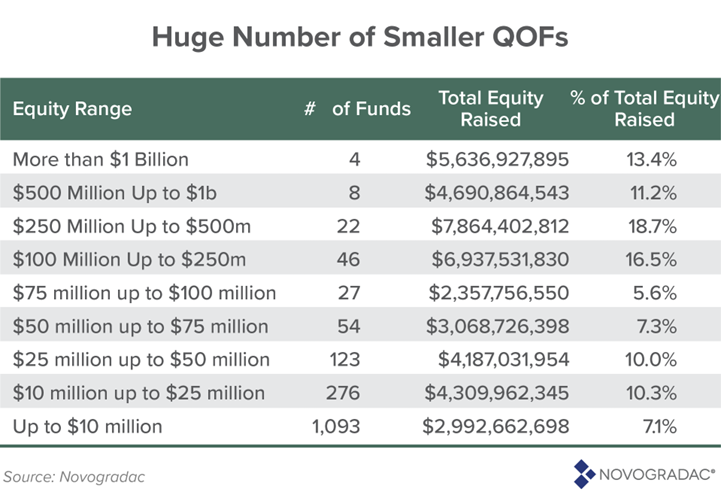
Puerto Rico's Original Special Status
When the original OZ tracts were designated in 2018, Puerto Rico received an extraordinary benefit written directly into statute: every eligible low-income census tract on the island was automatically designated as an Opportunity Zone. In all other states and territories, governor nomination was required, and a 25% limit of eligible tracts was imposed.
The numbers tell the story of how significant this was. Puerto Rico has 945 total census tracts. Under the 2010 ACS data used for OZ 1.0, 863 of those qualified as low-income communities - and all were automatically designated. Puerto Rico ended up with 865 designated OZ tracts, making it the second-largest OZ footprint in the entire United States, trailing only California's 879 zones. For context, California has roughly 30 times Puerto Rico's population.
Under OZ 2.0, that special rule is gone. The OBBBA explicitly repeals it. Puerto Rico will now be governed by the same 25% cap as every other state and territory. The new eligibility threshold is also tighter - median family income dropping from 80% to 70% of area median - so the eligible pool itself shrinks. Based on 2020-2024 ACS data, an estimated 710 Puerto Rico tracts qualify as low-income under the new criteria. Puerto Rico may designate 25% of those (approximately 178 tracts) as OZ 2.0 zones.
|
863 OZ 1.0 Designated Tracts (2018) |
~710 Tracts Eligible Under OZ 2.0 Rules |
~178 Maximum PR May Designate (25% cap) |
|
Puerto Rico goes from automatic full coverage to a deliberate choice — 178 designations out of 945 tracts. |
||
OZ 1.0 Map of Puerto Rico showing 863 of 945 census tracts confirmed as Opportunity Zones.
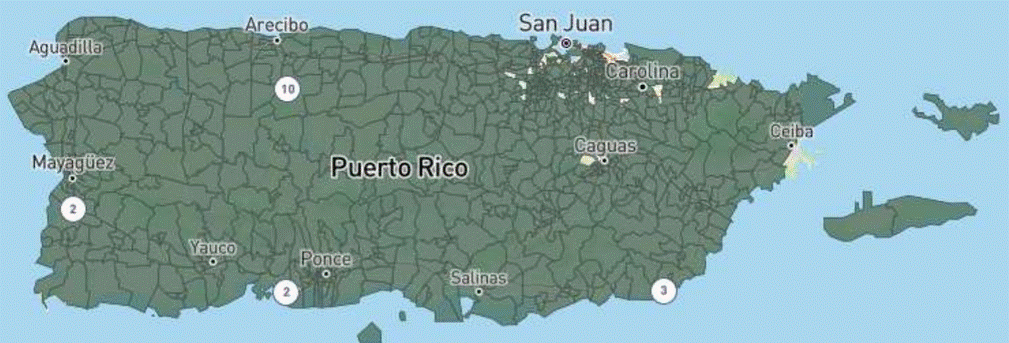
Source: Novogradac OZ 2.0 Interactive Mapping Tool - HERE
What the 2018 Program Accomplished and Where It Fell Short
Nationally, the original OZ program attracted at least $48 billion in capital into designated zones through 2023. The results demonstrated that the incentive structure works: investors respond to tax incentives. But the distribution of that capital was uneven in ways that shaped the design of OZ 2.0.
Research from the Urban Institute, the Economic Innovation Group, and others found three consistent patterns:
- Capital concentrated in tracts that were already on a development trajectory — urban areas with existing investor pipelines and strong market fundamentals.
- Truly distressed rural communities received a disproportionately small share of investment. The incentive was not powerful enough to overcome the market risk premium that rural assets carry.
- In many states, the 2018 designation process was opportunistic — governors used their 25% allocation on tracts adjacent to growth areas rather than genuinely distressed communities. The contiguous tract loophole made this easy.
These findings drove two key changes in OZ 2.0: tighter eligibility criteria to ensure genuine distress, and the creation of the Qualified Rural Opportunity Fund (QROF) structure with its 30% step-up, which was an explicit congressional acknowledgment that rural communities need a larger incentive to attract private capital. For Puerto Rico, understanding these lessons is essential to making the right designation choices in 2026.
Why Congress Redesigned the Program
The One Big Beautiful Budget Act of 2025 did not abandon Opportunity Zones, but made them permanent and corrected the structural weaknesses of the original program. The redesign reflects three congressional priorities:
- Sharper targeting. By tightening the income eligibility threshold from 80% to 70% and eliminating the contiguous tract loophole, Congress ensured that designated zones are genuinely distressed communities.
- A rural correction. The creation of the Qualified Rural Opportunity Fund designation with its 30% basis step-up versus the standard 10% is an explicit policy acknowledgment that rural communities were underserved by the original program. Congress created a larger incentive specifically to attract capital to rural America.
- A new designation cycle. The 2026 redesignation is an opportunity for every governor to make a different, more strategic set of choices than 2018. For Puerto Rico, it is a once-in-a-decade chance to compete on terms the island has never had before.
The timeline below places the full arc of the program in context:
|
2017 |
Tax Cuts & Jobs Act creates the Opportunity Zone program |
|
2018 |
First OZ designations — Puerto Rico receives automatic 100% island-wide coverage (863 tracts) |
|
2019–2023 |
Capital deployment phase — $48B+ invested nationally; rural communities underserved |
|
July 4, 2025 |
OBBBA signed — OZ 2.0 enacted; QROF created; Puerto Rico's special rule repealed |
|
July 1, 2026 |
Governor nomination window opens — 90 days to select new tracts |
|
Jan 1, 2027 |
OZ 2.0 designations take effect — new decade-long investment cycle begins |
|
2 |
What Changes Under the OBBBA - Opportunity Zones 2.0 |
A Permanent Program, Fundamentally Redesigned
On July 4, 2025, President Trump signed the One Big Beautiful Budget Act (OBBBA) into law. For Opportunity Zones, the headline is unambiguous: the program is now permanent. The December 31, 2026 sunset that had defined every investment decision since 2018 is gone. In its place, Congress established a rolling 10-year designation cycle - a perpetual engine of place-based investment beginning with the 2026 redesignation.
But permanence is only part of the story. The OBBBA also corrected the structural weaknesses of the original program by tightening eligibility, eliminating loopholes, and most significantly, creating an entirely new investment vehicle designed to channel capital into rural America. For Puerto Rico, these changes are not administrative details. They are the policy environment that will shape every dollar of private capital flowing to this island for the next decade.
The table below summarizes every significant change between OZ 1.0 and OZ 2.0:
|
Program Element |
OZ 1.0 (2017) |
OZ 2.0 (OBBBA 2025) |
|
Program duration |
Sunset Dec 31, 2026 |
Permanent - redesignated every 10 years |
|
Designation cycle |
One-time, 2018 only |
Every 10 years beginning July 1, 2026 |
|
Income threshold |
Median family income ≤ 80% of area median |
Median family income ≤ 70% of area median |
|
Contiguous tract rule |
Up to 5% of tracts could be non-LIC adjacents |
Eliminated entirely |
|
Puerto Rico rule |
100% of eligible tracts auto-designated |
Subject to 25% cap - same as all states |
|
Gain deferral period |
Fixed: due Dec 31, 2026 |
Rolling: due 5 years from investment date |
|
Basis step-up |
10% at 5 years; 15% at 7 years (both expired) |
10% at 5 years (uniform) |
|
Rural fund (QROF) |
Not available |
30% basis step-up at 5 years; 50% improvement threshold |
|
10-year exclusion |
Zero tax on appreciation - expires 2047 |
Zero tax on appreciation - rolling 30-year window |
|
Reporting |
Minimal |
Annual returns required; penalties up to $50,000 |
The 2026 Designation Window - The Clock Is Running
The redesignation process is not automatic. Governors of every state and territory must actively nominate eligible census tracts within a specific window.
- July 1, 2026: Governor nomination window opens. States have 90 days to submit their selections to the U.S. Treasury.
- Late 2026: Treasury certifies nominations and publishes the official OZ 2.0 designation list.
- January 1, 2027: New designations take effect. OZ 2.0 investment rules become operative for all new capital.
- December 31, 2028: OZ 1.0 tracts officially expire. Only OZ 2.0 designated zones remain.
- Income threshold lowered: Median family income must now be at or below 70% of the metropolitan area median (down from 80%). This disqualifies tracts that were on the margin under OZ 1.0 - the ones that were "low-income" in the technical sense but not genuinely distressed.
- High-income poverty tracts excluded: A tract that qualifies on the 20% poverty rate test is now disqualified if its median family income exceeds 125% of area median. This closes a loophole that allowed college-town tracts and similar anomalies to qualify.
- Contiguous tract rule eliminated: Under OZ 1.0, up to 5% of designations could be tracts adjacent to low-income communities that didn't independently qualify. This loophole (widely used in 2018 to designate fringe development areas) is gone entirely under OZ 2.0.
- Puerto Rico's special rule repealed: The statutory provision that automatically designated every eligible Puerto Rico tract is explicitly eliminated by the OBBBA. Puerto Rico now operates under the same 25% cap as all other jurisdictions.
- 30% basis step-up at 5 years vs. the standard 10% — meaning investors pay tax on only 70% of their original deferred gain instead of 90%.
- 50% substantial improvement threshold vs. the standard 100% — making it significantly easier and cheaper to rehabilitate existing properties.
The 90-day window means that governors who have not done the analytical and stakeholder groundwork in advance will be making consequential, decade-long investment policy decisions under time pressure. The jurisdictions that win under OZ 2.0 will be those that arrive on July 1, 2026 already knowing which tracts they intend to nominate and why.

OZ 2.0 Timeline for Governors.
Tighter Eligibility - What Qualifies as a Low-Income Tract Has Changed
Under OZ 1.0, a census tract qualified as a low-income community if its median family income was at or below 80% of the area median, or if it had a poverty rate of at least 20%. Under OZ 2.0, Congress tightened these standards in four meaningful ways:
What These Changes Mean Specifically for Puerto Rico
Taken together, the OBBBA changes produce a significant transformation in Puerto Rico's OZ landscape:
|
Factor |
OZ 1.0 |
OZ 2.0 |
What Changed |
|
Total census tracts (island-wide) |
945 |
945 |
No change |
|
Tracts qualifying as low-income |
863 |
~710 |
Tighter income threshold (80% to 70%) |
|
Special auto-designation rule |
Yes - 100% |
No - repealed |
Eliminated by OBBBA |
|
Maximum OZ Tracts |
863 (100%) |
~178 (25%) |
79% reduction in OZ footprint |
|
Contiguous tract allowance |
Yes |
No |
Eliminated - every tract must qualify independently |
|
Subject to same rules as U.S. states? |
No |
Yes |
PR now on equal footing for better or worse |
The bottom line is that Puerto Rico moves from a passive recipient of blanket federal coverage to an active policy decision-maker with 178 designations to allocate strategically. This is simultaneously a reduction in breadth and an increase in strategic opportunity. How the Governor's office uses these 178 designations will influence the character of Opportunity Zone investment on the island for the next decade.
The QROF - The Most Important Provision in the New Law
Among all the changes in the OBBBA, one provision stands apart in its potential impact on Puerto Rico: the creation of the Qualified Rural Opportunity Fund.
Congress recognized that rural communities were systematically underserved by OZ 1.0 - not because investors lacked interest, but because the incentive was not large enough to compensate for the additional risk and illiquidity premium that rural assets carry compared to urban ones. The QROF was designed to close that gap.
|
THE QROF: The New Investor Advantage A Qualified Rural Opportunity Fund (QROF) is a QOF that deploys at least 90% of its assets into rural Opportunity Zone tracts. "Rural" is defined by statute as any area outside a city or town with a population greater than 50,000, and outside any urbanized area adjacent to such a city. QROF investors receive two advantages over a standard QOF: The plain-English translation: the 30% step-up functions as an effective 30% discount on the investor's original tax liability. A $1M deferred gain is taxed as $700,000 instead of $900,000, producing real, immediate savings on top of the 10-year exclusion of appreciation. This is the incentive that will determine where serious rural capital flows over the next decade. CRITICAL NOTE FOR POLICY MAKERS: QROFs can only form and attract investors if there are sufficient rural OZ tracts to deploy capital into. Tract designation strategy determines whether a QROF ecosystem can develop on the island at all. |
For context on what the QROF advantage means in practice, the hypothetical comparison below shows a side-by-side investment scenario for a standard QOF versus a QROF investing the same capital:
|
|
Standard QOF (Urban) |
QROF (Rural) — Puerto Rico |
|
Original gain invested |
$1,000,000 |
$1,000,000 |
|
Basis step-up at 5 years |
10% |
30% |
|
Taxable deferred gain at year 5 |
$900,000 |
$700,000 |
|
Tax savings vs. no OZ investment |
Deferred |
Deferred + 20% reduction |
|
Appreciation after 10 years |
Tax-free |
Tax-free |
|
Substantial improvement required |
100% of basis |
50% of basis (easier to qualify) |
The 20-percentage-point difference in the step-up (30% vs 10%) is significant and will save most taxpayers about $60,000 on this hypothetical $1M investment. This original tax savings opportunity is what drives investors to OZs in the first place, and they will actively seek jurisdictions where rural OZ Funds are available. Puerto Rico can be that jurisdiction.
How "Rural" Is Defined and Why It Matters for Puerto Rico
The OBBBA defines a rural area, for QROF purposes, as any area that is not a city or town with a population greater than 50,000 inhabitants, and not part of an urbanized area contiguous and adjacent to such a city or town. The IRS codified this definition in Notice 2025-50 (September 2025), which also identified 3,309 census tracts within existing OZ 1.0 zones that qualify as rural under this standard.
For Puerto Rico, this definition is consequential. A significant share of Puerto Rico's municipalities sit well outside the 50,000-population threshold and its urbanized adjacency buffer.
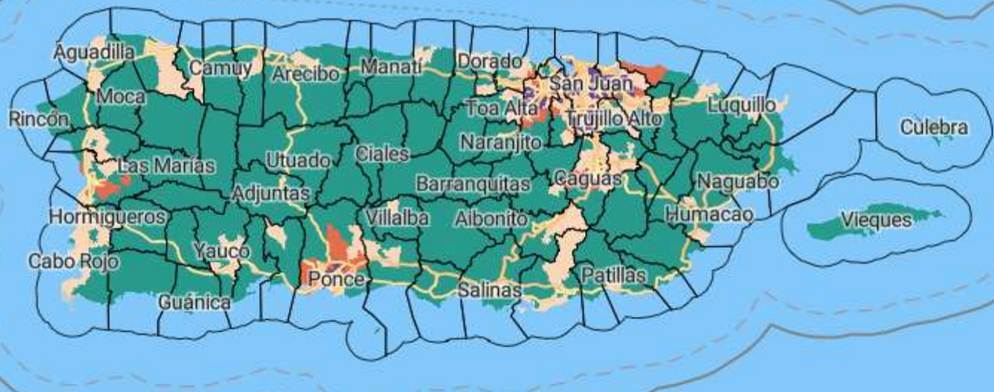
Treasury has not yet published the official rural tract map for OZ 2.0, which it is expected to do during Q2 2026. But publicly available data compiled by Novogradac shows us where those rural census tracts are and which ones are likely to be among the ~710 that are considered low-income:.
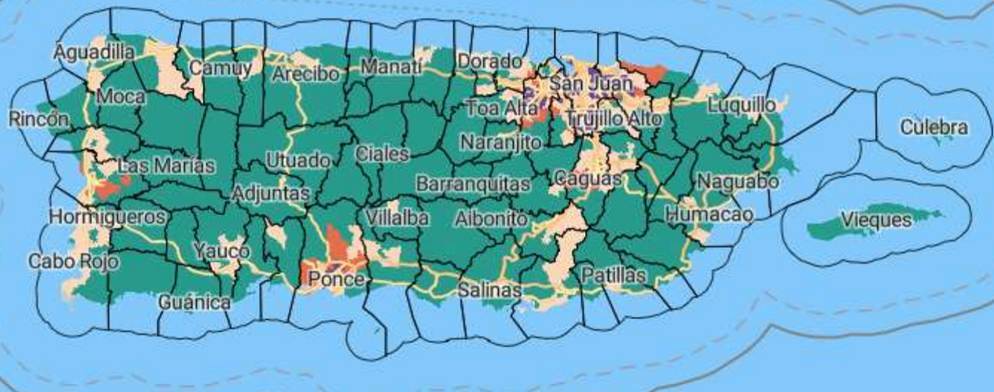
Map showing likely eligible (low-income) census tracts (Green, Orange, and Purple). All Green areas are likely to be rural.
The 2026 Transition - A Window of Opportunity
Industry analysts have noted the potential for a brief fundraising lull between January and December 2026 as investors wait for OZ 2.0 rules to fully activate on January 1, 2027. Capital gains realized in 2026 and invested under OZ 1.0 rules still receive deferral, but only until December 31, 2026 under OZ 1.0 mechanics. Investors who want the full rolling 5-year deferral and QROF benefits will generally wait for the OZ 2.0 window.
Puerto Rico has an opportunity to be a front-runner in raising capital in 2027 by positioning itself as the OZ destination where investors can defer gains, take advantage of Act 60 benefits, AND earn a 30% reduction in their tax bill by investing in rural projects through a QROF.
|
3 |
The Economic Development Opportunity for Puerto Rico |
Puerto Rico Stands at a Fork in the Road
In the summer of 2026, Puerto Rico's governor will select approximately 178 census tracts for Opportunity Zone designation. The question is not which tracts are eligible. Roughly 710 are. The question is what kind of investor Puerto Rico wants to attract, what kind of projects it wants to enable, and what kind of competitive position it wants to hold relative to every other U.S. jurisdiction making the same decision at the same time.
We see two distinct paths.
Path A: Default to Urban. Designate the 178 tracts that look most investment-ready, most of which will be in or near San Juan and other urban centers. In that case Puerto Rico competes as one of 56 jurisdictions with standard QOF zones, offering the same 10% step-up as Florida, Texas, New York, and every other state. Investors who were already looking at Puerto Rico may place capital here. Investors who were not will have no particular reason to start.
Path B: Designate Rural. Concentrate the 178 designations in rural municipalities, creating a critical mass of rural OZ tracts sufficient to attract the formation of Qualified Rural Opportunity Funds. Puerto Rico becomes one of a small number of U.S. jurisdictions with a genuine QROF ecosystem, offering the 30% step-up that urban designations cannot. Investors who want the superior QROF incentive have to come here.
Monllor Capital’s position is clear: Path B is the only one that creates a lasting competitive advantage for Puerto Rico. Path A is a missed opportunity.
|
PATH A: Urban Default Competitive parity with 55 other jurisdictions. Standard 10% step-up. No QROF ecosystem. |
PATH B: Rural Strategy First-mover QROF jurisdiction. 30% step-up. Unique capital magnet for Puerto Rico. |
Why QROF Formation Requires Critical Mass
A Qualified Rural Opportunity Fund must deploy at least 90% of its assets into rural OZ tracts. A fund manager in New York or Miami who wants to launch a QROF needs a pipeline of investable projects in rural OZ territory large enough to justify fund formation, capital raising, and portfolio management.
If Puerto Rico scatters a handful of rural designations, no fund manager will build a QROF around the island. The deal flow will not support it. But if policy makers are aggressive about rural zone designation, it creates the conditions for fund managers to bet on QROF status so they can say to investors: "Puerto Rico is our market. Here is our pipeline. Here is why this is the most tax-efficient rural investment available in the United States."
The chain of causation is fixed: QROFs will not form unless the tracts are there. The tracts only exist if the governor designates them.
|
Governor designates rural tracts (2026) |
-> |
Critical mass of rural OZ inventory created |
-> |
QROF managers build PR investment pipelines |
-> |
U.S. capital flows to rural PR at 30% advantage |
What the 30% Step-Up Could Mean to a Real Investor
An investor sells a business or portfolio and realizes a $5 million capital gain. At a blended 30% rate (accounting for federal and state taxes), that investor normally writes a check for $1.5 million.
Under OZ 2.0, that investor defers the entire $5 million by placing it in a QOF within 180 days. At year five, the step-up reduces the taxable gain:
- Standard QOF: 10% step-up. Taxable gain becomes $4.5M. Tax owed: $1.35M.
- QROF (Puerto Rico rural): 30% step-up. Taxable gain becomes $3.5M. Tax owed: $1.05M.
The QROF investor saves $300,000 compared to a standard QOF on the same gain. Then, if the investor holds ten years, all appreciation on the OZ investment itself is tax-free. A $5M investment that grows to $12M produces $7M in completely untaxed gains. No other mechanism in the U.S. tax code comes close.
|
|
No OZ |
Standard QOF |
Puerto Rico QROF |
|
Original gain |
$5,000,000 |
$5,000,000 |
$5,000,000 |
|
Tax owed at sale |
$1,500,000 |
Deferred |
Deferred |
|
Step-up at year 5 |
None |
10% |
30% |
|
Taxable deferred gain |
$5,000,000 |
$4,500,000 |
$3,500,000 |
|
Tax on deferred gain (30%) |
$1,500,000 |
$1,350,000 |
$1,050,000 |
|
Tax on 10-yr appreciation |
Full rate |
Zero |
Zero |
|
Net advantage |
Baseline |
Meaningful |
Compelling |
What Types of Investment Flow to Rural Puerto Rico
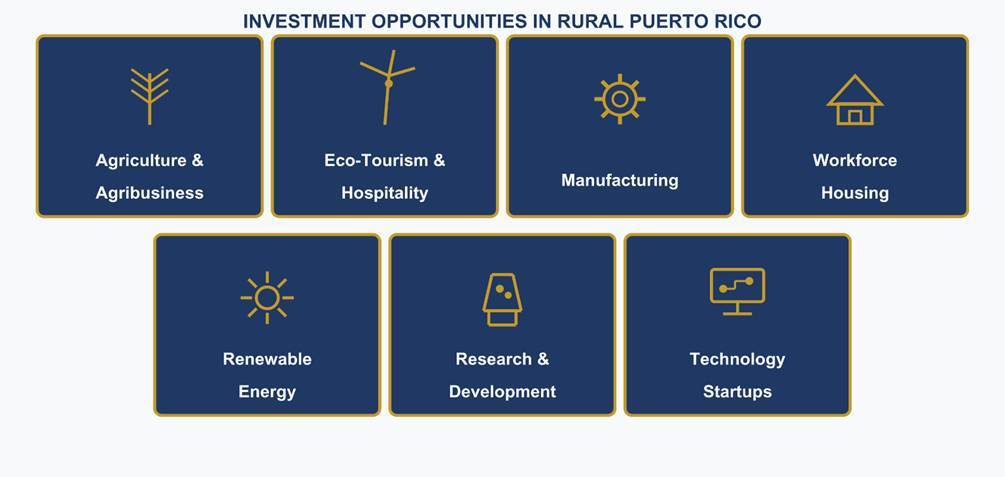
The QROF structure is well-suited to attract capital across at least seven categories that align directly with Puerto Rico's geography, workforce, and existing incentive infrastructure:
- Agriculture and agribusiness. Cold storage, processing facilities, controlled-environment agriculture, and farming on Puerto Rico's substantial underutilized agricultural land.
- Eco-tourism and hospitality. Boutique resort development, adventure tourism, and eco-lodging in coastal and mountain municipalities with world-class natural assets and limited existing capacity.
- Manufacturing. Puerto Rico's geographic position, bilingual workforce, and Act 60 incentives make it a logical nearshoring destination. Rural QROF zones anchor industrial development in municipalities with available land and PRIDCO facilities.
- Workforce housing. Rural municipalities face severe supply constraints. The QROF's 50% improvement threshold makes rehabilitation of existing structures significantly more viable than under OZ 1.0.
- Renewable energy. Puerto Rico's solar irradiance, wind resources, and grid resilience mandate create strong fundamentals for renewable energy projects. QROF capital is well-positioned for utility-scale solar, battery storage, and distributed energy infrastructure.
- Research and development. Puerto Rico's research universities, pharmaceutical heritage, and federal grant eligibility create a foundation for R&D that can be done in rural areas as well as urban.
- Technology startups. Act 60 already attracts tech founders to the island. Rural OZ designation creates a second layer of incentive for startup campuses, data centers, and tech infrastructure in non-metro municipalities.
Puerto Rico's Structural Advantages Under OZ 2.0
Puerto Rico enters the QROF competition with structural advantages no mainland rural county can replicate:
|
Act 60 Stacking |
Investors who become bona fide Puerto Rico residents pay 0% on capital gains generated on the island. Combined with the QROF 30% step-up, this benefit stack is unmatched anywhere in the United States. Furthermore – most new or growing operating businesses in the identified sectors will benefit from a tax decree, offering more incentive for off-island capital. |
|
Geographic Concentration |
Puerto Rico is an island. Rural municipalities share one regulatory framework, one economic development agency, and one coherent market. A QROF built around Puerto Rico is not managing risk across five rural counties in three states. |
|
Federal Program Accessibility |
As a U.S. territory, Puerto Rico is fully eligible for all federal investment programs. No foreign investment complications. No currency risk. No legal structure barriers. |
|
DDEC's Existing Infrastructure |
The OZ 2.0 strategy layers onto an economic development apparatus that already exists, with established investor relationships and a track record of attracting U.S. capital. |
|
First-Mover Position |
Most governors will make their 2026 designations without a coherent rural strategy. Puerto Rico can be the first jurisdiction to announce a deliberate QROF-focused designation strategy, defining the conversation for investors and fund managers before the new rules kick in on January 1, 2027. |
The Cost of Getting This Wrong
Capital is going to flow into urban census tracts regardless of strategy. The risk of Path A is a lost opportunity to bring capital that was otherwise going to stay in the US.
Urban designations put Puerto Rico in direct competition with New York, Miami, and Los Angeles for the same pool of standard QOF capital. Puerto Rico will not win that competition on investment fundamentals or risk management.
Rural designations, done right, put Puerto Rico in a category of ONE. The capital that flows is not incremental. It arrives in the form of funds built specifically around Puerto Rico, with Puerto Rico-based managers, Puerto Rico-based deal pipelines, and Puerto Rico-based jobs.
This decision cannot be undone. The next opportunity to reset is 2036.
|
4 |
Process and Next Steps |
The Nomination Timeline
Starting July 1, 2026, Puerto Rico's governor has 90 days to submit a list of nominated census tracts to the U.S. Treasury. Treasury reviews the nominations for eligibility and certifies the final list before year-end. Designations take effect January 1, 2027.
How Tracts Are Selected
The selection process has two layers: eligibility and strategy.
Eligibility is determined by federal data. A census tract qualifies for OZ 2.0 nomination only if it meets the low-income community criteria under the 2020-2024 ACS data. Puerto Rico has approximately 710 such tracts. That is the universe from which the governor may nominate up to 178.
Strategy is entirely within Puerto Rico's control. Federal law imposes no criteria for how a governor chooses among eligible tracts. There is no requirement to select the most distressed tracts, the most investment-ready tracts, or any particular geographic distribution. The governor has full discretion within the 25% cap.
A rigorous selection process should evaluate each eligible tract across three dimensions:
|
1 |
Economic Development Alignment |
Does designation here serve Puerto Rico's broader economic development goals? Does it support job creation in municipalities with chronic unemployment, or address housing supply in workforce-critical areas? |
|
2 |
Rural Eligibility |
Does the tract qualify as rural under the OBBBA definition (outside cities and urbanized areas with populations over 50,000)? Only rural tracts can anchor QROF formation. |
|
3 |
Investment Readiness |
Is this census tract in a “Goldilocks” zone? Not too “hot” (already attracting capital without another incentive)? And not too “cold” (unattractive for investment, regardless of incentives)? Tract selection should focus on those where the designation will make a difference. |
Analytical Tools Available Now
Three tools are available today to begin analyzing strategic options:
|
Tool |
What It Does |
|
Novogradac OZ 2.0 Mapping Tool
|
Interactive map showing every Puerto Rico census tract flagged as eligible or ineligible under OZ 2.0 criteria based on 2020-2024 ACS data, as well as an overlay of rural and urban tracts. |
|
Urban Institute OZ 2026 Selection Tool
|
Policy analysis tool that scores eligible tracts on economic distress, development readiness, and expected capital flow. Helps identify which eligible tracts are most likely to generate real economic impact. Unfortunately, they don’t provide information for Puerto Rico, but looking at the concept will be useful. |
|
IRS Notice 2025-50 Rural Tract List
|
The IRS has identified 3,309 census tracts nationally that qualify as rural under the OBBBA definition within existing OZ 1.0 zones. Allows Puerto Rico to identify the intersection of OZ 2.0 eligible and QROF-eligible tracts today, before Treasury publishes its official OZ 2.0 rural map. |
|
Where Monllor Capital Fits |
|
On-Island Deal Flow Intelligence. MCP has a credible investment pipeline and is in regular communication with a range of entrepreneurs seeking capital. This market knowledge gives us confidence in the ability of PR to support multiple Private Equity/Opportunity Zone Funds. |
|
OZ Investor Relationships. MCP has relationships with mainland U.S. capital sources actively evaluating OZ opportunities in the US and Puerto Rico. We strongly believe a QROF offering focused on Puerto Rico will be effective in “tipping the scales” in favor of Puerto Rico. |
|
Structural Expertise. We’ve been involved in the Opportunity Zone space since 2019 and are the only ones on the island actively working to raise outside OZ capital for investment here. We know the mechanics of the program and are committed to PR.
We Stand Ready- to be a resource for DDEC in navigating this process to achieve the goal of using this FREE federal program to position Puerto Rico as a destination for US Capital for the next decade or more. |
|
The Clock The nomination window opens July 1, 2026. States that arrive ready will have completed their tract analysis, secured internal alignment, and begun conversations with the investment community. We encourage policymakers to start now. |
|
5 |
What Winning Looks Like |
|
PR |
Puerto Rico-Based QROFs Raising Capital Puerto Rico-based Qualified Rural Opportunity Funds are actively raising capital from mainland U.S. investors. Fund managers have built deal pipelines across rural municipalities. Projects in agriculture, manufacturing, renewable energy, eco-tourism, and workforce housing are closing with QROF capital as the financing anchor. |
|
JOBS |
Jobs Where They Are Needed Most Rural municipalities that have seen decades of population and economic decline are receiving private investment at a scale that public programs alone could never generate. The jobs created are not just in San Juan. They are in Naguabo, Utuado, Arecibo, Yauco, Culebra, and others. |
|
DDEC |
DDEC Owns a Measurable Win DDEC can point to a program it shaped, a strategy it executed, and outcomes it can measure. Capital attracted. Jobs created. A replicable model for the next cycle. Puerto Rico becomes a national model for how to use the OZ program to attract capital to a state or territory; but we have a 10-year head start. |
The Compounding Effect
The OZ 2.0 designation cycle repeats in 2036. A Puerto Rico that executes well in 2027 through 2036 arrives at the next cycle with a track record, an investor base, and a fund ecosystem already in place. The compounding effect of a good first cycle is significant.
A Final Word
Puerto Rico has a long history of building economic development programs around tax incentives. Every one of those programs has a cost to the island: foregone revenue, administrative infrastructure, and the ongoing political work of keeping them intact. But, Opportunity Zones are different.
The Opportunity Zone program is a federal program funded by the U.S. tax code. The capital is from the mainland. The incentive costs Puerto Rico nothing. The only input required from the Puerto Rico government is a list of 178 census tracts and the strategic clarity to choose the right ones.
Done well, that decision positions Puerto Rico as a leader among 56 competing jurisdictions, channels private investment into municipalities that have waited decades to see it, creates jobs outside the metro area, and improves quality of life in communities around the island.
***
Connect HERE if you want to start a conversation.
Sign up HERE to get weekly insights on a range of topics like this from PR PROZ. .
Shawn L. Hanson, Managing Partner
shanson@monllorcapitalpartners.com
(608) 385-5377
Disclaimer
This content is provided for informational purposes only and does not constitute legal, tax, or investment advice. The authors have made reasonable efforts to ensure the accuracy of the information contained herein as of the date of publication; however, laws, regulations, and guidance may change, and no guarantee is made as to the completeness or accuracy of the content.
Readers should not rely solely on this material for making investment or tax decisions. All investors are strongly encouraged to consult with qualified tax, legal, and financial professionals before acting on any information contained in this document.
Nothing herein constitutes an offer to sell, or a solicitation of an offer to buy, any security or investment product.